
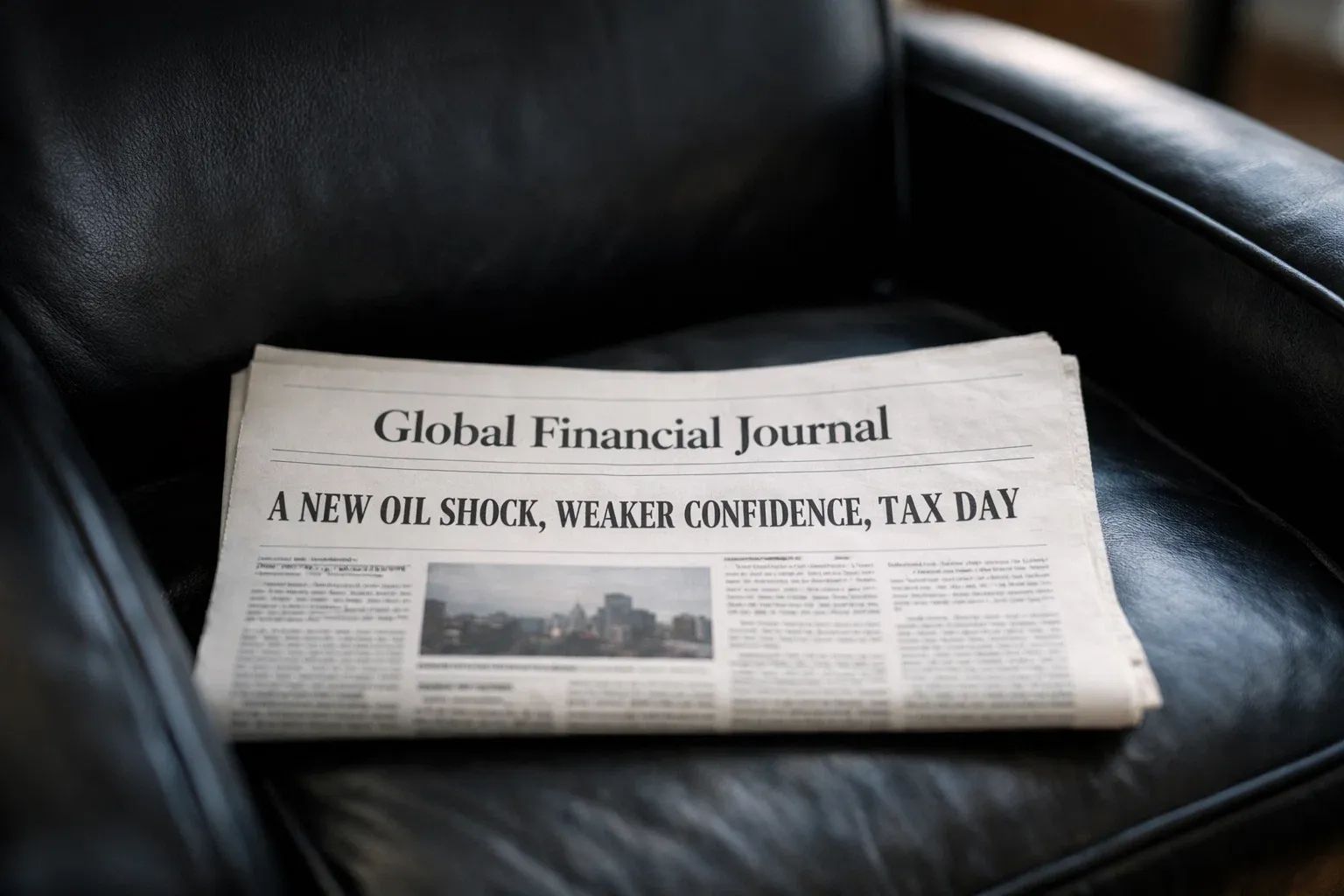
When Tax Day Meets a New Oil Shock

Pay No Interest Until Nearly 2027
Did you know some credit cards could actually help you get out of debt faster?
Yes, it sounds crazy. But it’s true.
The secret: Find a card with a “0% intro APR" period for balance transfers.
Then, transfer your debt balance and pay it down as much as possible during the intro period.
No interest means you could pay off the debt faster.
The two-week ceasefire that briefly calmed markets is effectively over.
After 21 hours of talks in Islamabad that failed to produce an agreement, President Trump announced Sunday that the U.S. Navy will begin blockading "any and all Ships trying to enter, or leave, the Strait of Hormuz" starting Monday morning. The blockade is intended to deny Iran both the leverage and the revenue it has been extracting by controlling the passage. In doing so, it removes roughly 2 million barrels per day of Iranian oil from the market on top of the disruptions already in place.
Oil rose 8% on Sunday to around $102 a barrel. A Columbia University energy analyst told CNN that even after the war ends, prices may not decline quickly because the strait needs to be reopened and damaged infrastructure repaired. "For now and into the end of 2026 we're looking at elevated oil prices for certain," she said.
Markets can move quickly on a headline. Household budgets, energy risk, and liquidity conditions adjust on a slower and harsher timetable.
What the Blockade Changes
The ceasefire created a brief window in which markets could imagine the conflict de-escalating on a clear timeline. That window has closed. The blockade is not a step toward resolution. It is an escalation designed to force one, and the outcome is genuinely uncertain. Iran's parliamentary speaker responded by posting a map of gas prices near the White House and writing that Americans would "soon miss $4 to $5 gasoline."
Gas nationally was already averaging $4.12 on Sunday, up 38% since the war began in late February. The blockade adds a new layer of pressure on top of a cost structure that was already making March the most expensive month for household energy in four years. That is not a short-term problem. Oil infrastructure damage takes months to repair even after hostilities stop.
That matters for planning. March inflation came in at 3.3% annually, with energy accounting for the bulk of the move. If oil stays elevated or climbs further through the spring, the April and May CPI numbers will carry that pressure forward. The Federal Reserve has no clean path to rate cuts in that environment.
The Public Was Already Losing Confidence
Before Sunday's announcement, the University of Michigan's preliminary April consumer sentiment reading had already fallen to 47.6 — a record low in the survey's 70-year history, below levels hit during the 1980 energy crisis. One-year inflation expectations had jumped to 4.8%. That survey was conducted almost entirely before the ceasefire was announced. It reflects a public that was already factoring in the cost and uncertainty of the conflict before any of this weekend's developments.
That gap matters. Markets price probability. Households price lived experience. A stock index can recover on a day of optimism. Confidence inside households recovers more slowly, especially when the pressures feel practical rather than theoretical: fuel, groceries, delivery costs, and the monthly math of carrying expensive debt.
A Third Pressure Nobody Is Talking About
This week carries a third pressure that tends to get overlooked until it is already underway.
Tax Day on April 15 does not just close the filing season. It also pulls a significant amount of cash out of the private sector at once, as households and investors move money to the Treasury. The effect is not always dramatic. It matters more when markets are already dealing with tighter funding conditions — which they are, given the private credit stress, elevated yields, and the latest geopolitical escalation all arriving simultaneously.
Taken together, the week ahead presents a less forgiving setting than the brief ceasefire rally suggested. A renewed energy shock. Record-low consumer confidence. A mid-month liquidity drain. And bank earnings — Goldman Sachs Monday, JPMorgan Tuesday — that will reveal whether the credit quality of U.S. consumer loan books has started to show the strain that higher gas prices and tighter household budgets would logically produce.
While the Strait Stays Closed, One Number Keeps Growing
This is the kind of environment where budgets feel tighter before balance sheets visibly break. Higher fuel costs, weaker confidence, and frozen rate relief reinforce each other. They do not need a full-blown crisis to cause real damage.
The most direct response for most households is not to wait for policy to improve conditions. It is to reduce the costs that are both expensive and within your control. A revolving credit card balance at 22% APR compounds regardless of what happens in the Strait of Hormuz. It does not benefit from geopolitical uncertainty. It does not hold its value. It just grows.
That adjustment does not require a crisis to be worth making. It requires only a clear-eyed look at which parts of your financial picture are getting harder to defend.
Tackle your credit card debt by paying 0% interest until 2027 (Ad by FinanceBuzz)
Written by Deniss Slinkins
Global Financial Journal