
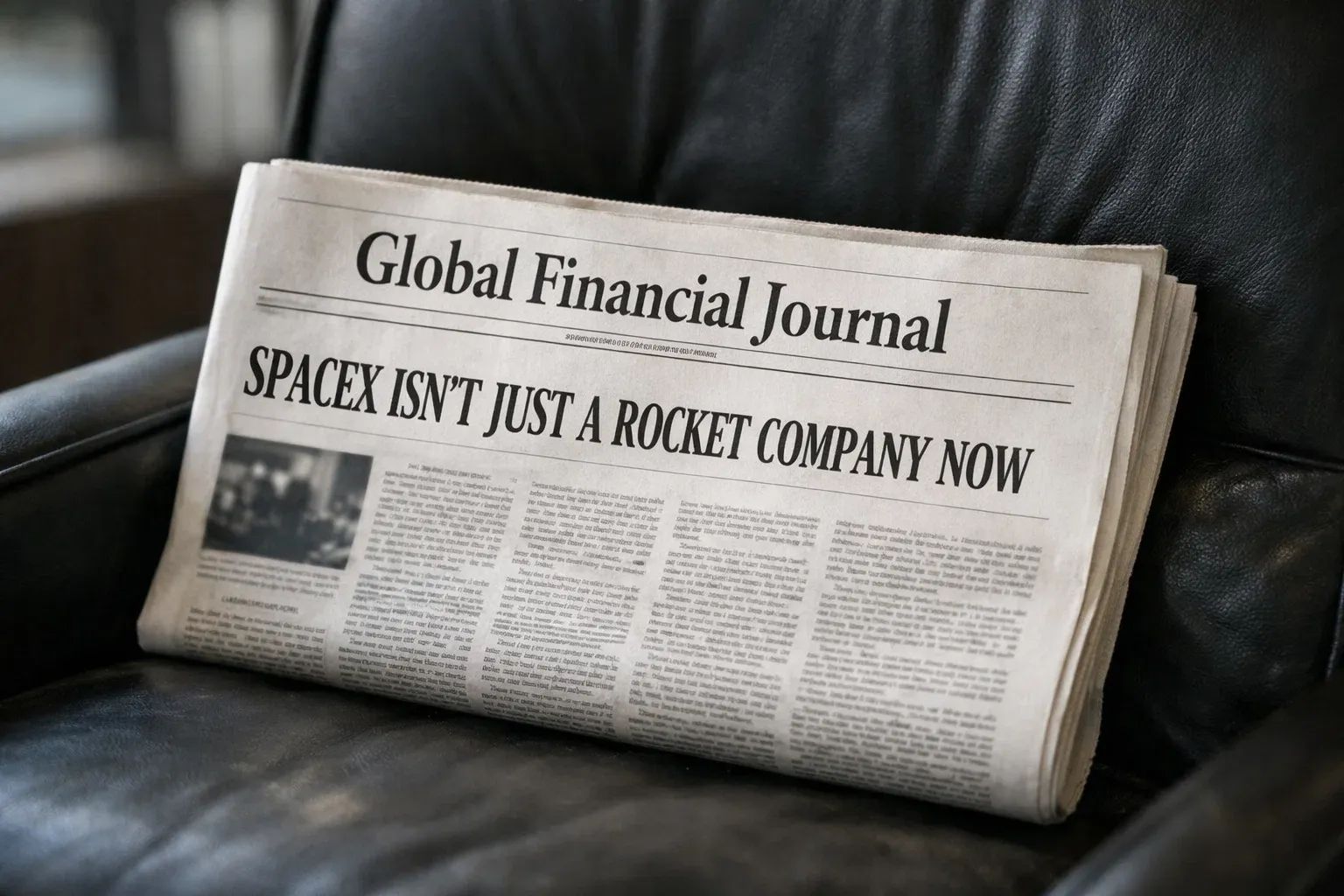
SpaceX Isn't a Rocket Company Anymore. The Market Just Figured That Out

Editor’s Note: What if you could claim a stake in what’s set to be the biggest IPO ever… starting with just $500? Click here to see the details from former tech executive and angel investor Jeff Brown — the man who picked Bitcoin, Tesla, and Nvidia before they exploded higher. Or read more below.
What if you could claim a stake in what’s set to be the biggest IPO ever… starting with just $500?
Click here to see the details because everyone is talking about Elon Musk’s SpaceX IPO.
CNBC called it “the big market event of 2026.” And The New York Times predicted…
This IPO “will unleash gushers of cash for Silicon Valley and Wall Street.”
You see, this is NOT about launching rockets to Mars, satellite internet, or anything you’ve heard from the media.
It’s much bigger than that…
Because this IPO is a key part of Elon Musk’s secret AI masterplan…
A plan that I believe will unlock the full power of artificial intelligence...
Unleashing what Elon Musk is predicting will be…
A $1 quadrillion new wealth wave.
Just to put that into perspective…
That would be enough to send a check for $2.8 million to every single man, woman, and child in America.
That’s how big this opportunity is.
Click here to get the details and I’ll show you how to claim your stake…
Starting with just $500.
We have so much to look forward to.
There are weeks when the market wants safety.
This is not one of them.
The S&P 500 and Nasdaq are back at record highs, helped by strong earnings, renewed appetite for large-cap tech, and growing optimism that diplomacy with Iran might keep the energy shock from getting worse. Major indexes pushed to fresh highs on April 15, and futures edged higher again on April 16 as investors leaned into strong bank earnings and hopes for resumed Middle East talks.
That matters because it changes what investors are willing to believe again.
Why SpaceX Is the Trade That Makes Sense Right Now
For weeks, markets were dominated by oil, inflation, and the risk that the Strait of Hormuz disruption would push the global economy into a harder slowdown. Those risks are not gone. Brent is still around the mid-$90s and WTI around the low-$90s, with about 13 million barrels per day of disrupted oil flows still shaping the market's outlook. But even with that backdrop, investors are once again paying up for growth, scale, and future optionality.
That is what makes the SpaceX story so timely.
SpaceX has confidentially filed for what could become the largest IPO on record, at a reported valuation around $1.75 trillion. More important than the size is the reason Musk says he wants the money: orbital data-center satellites designed to bypass power and water constraints on Earth. That means the market may soon be asked to value SpaceX not only as a rocket company or a satellite business, but as a large-scale AI infrastructure bet.
That is a very different story than the one most people still associate with the company.
The usual framing is rockets, launches, Starlink, and Mars. The market framing is becoming broader. If AI is moving from software into power, chips, data centers, and physical infrastructure, then SpaceX begins to look like a capital-intensive platform story with far more optionality than a traditional aerospace listing. SpaceX posted a nearly $5 billion loss in 2025 on revenue of more than $18.5 billion — a reminder that the scale story comes with real execution risk. But this is the kind of market that can look past current losses if it believes the future addressable market is big enough.
Right now, that belief is clearly back.
The Fed Transition Nobody Is Talking About
The backdrop is not calm, even if the tape looks confident.
Oil is still elevated. The Strait of Hormuz is still constrained. The market remains skeptical that renewed U.S.-Iran talks can quickly normalize flows. And the Federal Reserve is heading into a leadership transition that looks less orderly than markets would prefer. Jerome Powell's term as chair ends on May 15, Kevin Warsh's path is politically complicated, and high oil prices make rate cuts less likely in the near term.
In other words, the risks have not faded. The market is simply choosing, for now, to pay for upside anyway.
What This Moment Is Really About
Today's story is not just about a single IPO.
It is about the return of a broader market instinct: when confidence comes back, even partially, investors do not just buy safety. They buy the biggest expression of the future they still want to believe in. The same tape that is rewarding mega-cap tech and pushing indexes to records is the tape that makes a blockbuster SpaceX IPO feel believable rather than premature.
At the moment, SpaceX may be the clearest version of that trade.
Not because the world suddenly looks stable. Because the market is willing, once again, to pay for scale before stability is fully restored.
Have $500? Invest in Elon’s AI Masterplan (Ad by Brownstone Research)
Written by Deniss Slinkins
Global Financial Journal